Building date: 1850
Original use:
Corner structures:
Mortar application and content:
Types and uses of stones:
Types and choice of windows:
Structures with similar masonry details:
Masons who worked on building: Chester Clark, mason, and his helper Lyman Johnson
Unique features:
Map views courtesy Google Maps. Address is Google Earth confirmed; 42°30'04.18"N 89°01'50.38"W. Current owner of record, Beloit Chapter of the National Society Daughters of the American Revolution as of the 2019 Tax Roll.
City of Beloit and Rock County Maps.
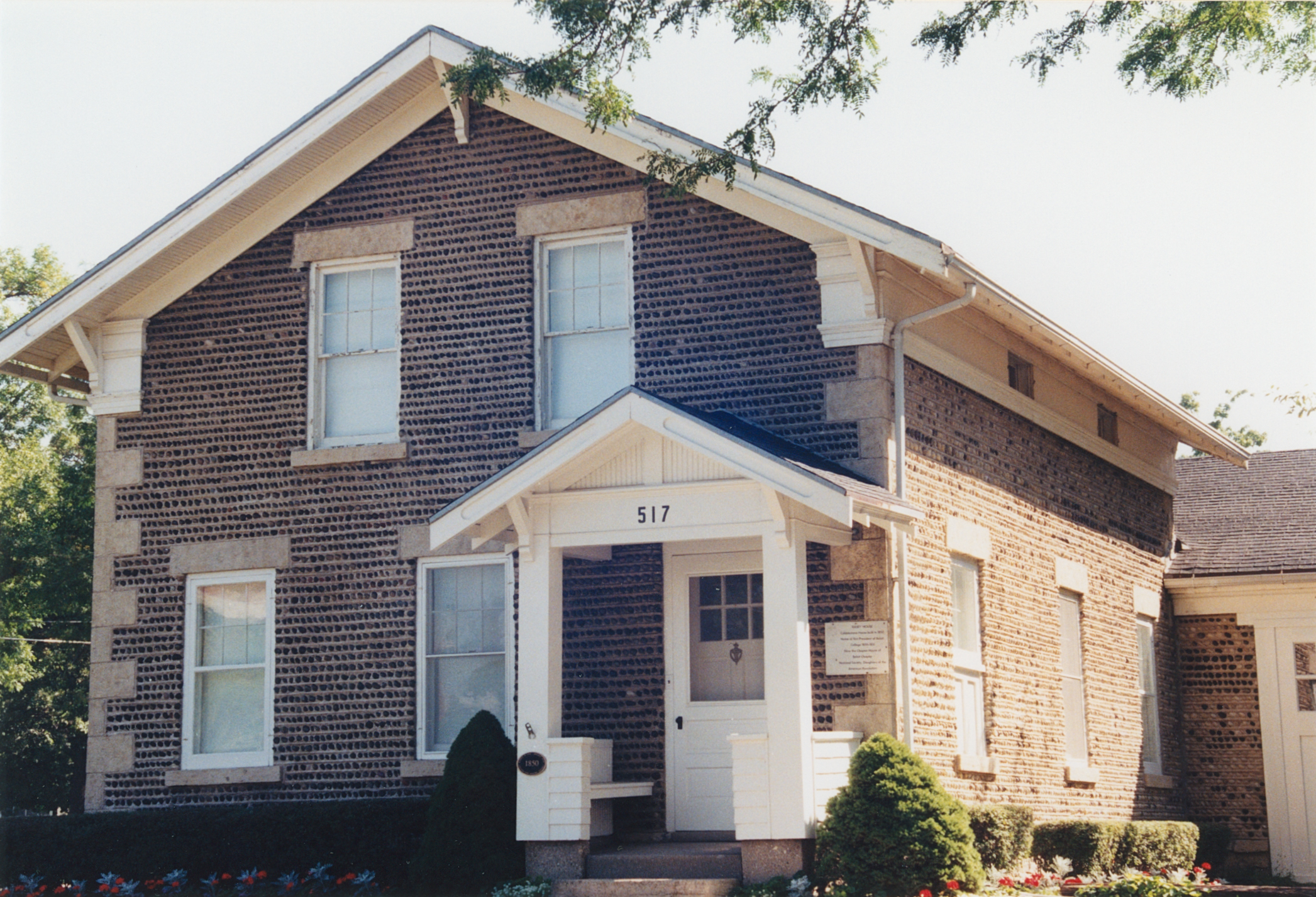
This cobblestone house at 517 Prospect St. in Beloit was built in 1850 as a Beloit College fund raising project. It was originally occupied by the first college president. Chester Clark was the mason. Built of grey cobblestones gathered from the bed of Turtle Creek, the Rasey House (or the Deacon Samuel Hinman House) is architecturally significant as a well-preserved example of Rock County's cobblestone houses. A one and one-half story building, the house is a simple rectangle in plan. The cobblestones are arranged in thin horizontal rows separated by half-round projecting mortar joints, a type of construction "frequently" used in Rock County, according to architectural historian Richard Perrin, and which "may be seen to good advantage in the Rasey House."
The main (west) facade is a simple composition with three first-floor openings, the southernmost being the doorway, and two second-floor window openings. Stone blocks are used as sills and lintels on all openings in the cobblestone fabric and also as quoins. The side (south and north) facades have three symmetrical window openings on the first floor, except on the north where the middle window has been covered by a later chimney. The rear (east) facade is masked by an attached one-story enclosed porch. A porch added to the front facade in the 20th century appears to be a bungalow design.
The Rasey House has a unique historical association with the growth of Beloit College. Originally constructed as a fund raising project for the young school, the house was built from a subscription of donated labor and materials. When the house was sold at the end of 1851 to Deacon Samuel Hinman, the sale price helped replenish empty college coffers. Immediately prior to its sale, from June, 1850 to November, 1851, the house was the residence of Professor A. L. Chapin, the College's first president and the man who designed the school's first curriculum. The house is a Wisconsin Registered Landmark and was entered on the National Register of Historic Places December 27, 1974. It is owned and maintained by the Beloit Chapter of the National Society Daughters of the American Revolution. Richard Palmer blog.
Permanent File of Cobblestone Structures
Beloit Daily News
Harriet Dawson - SOCIETY - Monday
DAR (dedication of plaque Sunday, July 16, 1967
"The Wisconsin Council for Local History is pleased to present landmark number 50 to Rasey House," Miss Doris Platt, in charge of museum education, radio and television for the State Historical Society of Wisconsin declared at the dedication of the plaque Sunday afternoon. The Wisconsin Council for Local History, a committee of the Wisconsin Historical Society, conducts the Wisconsin Landmarks Program to complement the state markers program for historical sites along Wisconsin highways. Fifty-six landmarks have been approved so far.
Rasey House stands on what was once part of Horace White Park, according to Walter Dundore, President of the Beloit Historical Society.
"The cobble-stone house on the corner of Bushnell and Prospect Streets was first occupied by Aaron Lucius Chapin, first president of Beloit College, according to letters which Mrs. R. K. Richardson discover in the college archives," Mrs. David Fifield, President of the Rasey House Corporation said. "The house was constructed and sold in order to raise money to finish Middle College on the college campus at a time when pork was 1-3/4 cents per pound and money scarce."
Mrs. Arthur Ellis, Regent of the Beloit Chapter of the Daughters of the American Revolution, introduced the speakers and special guests including Richard P. Hartung, director of the Rock County Historical Society and the Lincoln-Tallman Museum in Janesville.
About sixty were present for the ceremony, tour of Rasey House, and refreshments.
Transcription of deteriorated news release that was attached to the Permanent File of Cobblestone Structures.
Madame State Regent,
Madame Chapter Regent,
Distinguished Guests,
Members and Friends:
I wish to preface my remarks on the history of Rasey House by expressing my gratitude and appreciation to Mrs Robert K. Richardson, who searched for and compiled much of the information I have assembled.
Mrs. Richardson writes --- "In working in the document incident to the edition of Mr. Richardson's History of Beloit College, I have kept my eyes open for references to the building of the house long known as the Hinman House, now the Rasey House, which bears a relationship to the College which no other house I know of bears to any other college. It is common knowledge that its construction aid in the financing of the college building now known as Middle College."
Again quoting from Mrs. Richardson and her sources ---
"Four thousand dollars had been collected and spent in the summer of 1847 in putting up the bare brick walls of Middle College. Outsiders said that Beloit must finish the building or outside funds could not be obtained. The winter of 1848-1849 was a time of money scarcity. Wheat was about 37 cents per bushel and pork 1 3/4 cents per pound. The work of finishing the building went on slowly and the workmen were paid mainly in orders on the stores. The treasurer had to use $800 from the investment fund of the college to get the building finished. That sum must of course be replaced. But how?
"There were unused subscriptions of work but no money. The building agent hit upon a this plan. For fifty dollars he bought a lot on Prospect Street and built all those subscriptions into a house on it. Boys from the college were used to gather cobblestones from the bed of Turtle Creek. The large piles of broken brick about the college building were utilized to fill up the body of the cement walls behind the cobblestone framework; the Messrs. Gates made the cut stone for the corners; Chester Clark, mason, and his helper Lyman Johnson, here worked out their subscriptions as did many other workmen. That building, which with the lot cost nominally fourteen hundred and seventy-five dollars, was sold for all it cost and the $800 'loan' from the investment happily replaced.
On July 22, 1850, the College Executive Committee sent a sub-committee of L.G. Fisher, Stephen Peet and W.A. Talcott to "assess the value and determine the rent of the house." It stands to reason that in the growing community like Beloit in the 1850's a good new house would not remain empty, especially when the college was so anxious to secure money. Someone rented the house, and had the distinction of being the first tenant --- and that someone prove to be none other than President Aaron Lucius Chapin and his family, who conferred upon the house this distinction of being the first presidential residence.
The proof lies in the two letters written by President Chapin to his mother in Hartford, Connecticut. One dated June 25, 1850 states --- "We are anticipating, in a week or so, a removal of ourselves and our substance into the house which will be our permanent home until I am disposed to build for myself. Our accommodations will be small but quite convenient."
And in the second letter dated July 9, 1850, Mr. Chapin wrote --- "We are arranging a room for you in the new house we shall get into in a few days, which does not encroach upon our accommodations."
President Chapin was inaugurated July 24, 1850.
The house was not sold to Deacon Hinman until March, 1856, although he may have lived in it earlier, as a renting tenant.
Just last year Mrs. Richardson came upon another interesting bit of information in the Beloit College Round Table of October, 1880, from which I quote --- "On the corner of Bushnell and Prospect Streets, in close proximity to the college grounds, where the birds and crickets, in close proximity to the college grounds, sing sweet lullabies to the students of nature, and where the grateful shade of a few trees shields a cobblestone house from the sun's constant rays, there at morning, noon and night gather about twenty youths to satisfy there desire for things temporal. Levick is disbursing clerk." --- end of quote. (You may form your own conclusions.)
Since that day in 1856 there have been several owners and renting families. The last owners and residential occupants were Mr. and Mrs. E. L. Rasey.
The house has been somewhat remodeled from its original plan. The front and back parlors were made into a room, and a fireplace was added. The doorway leading to the downstairs bedroom on the south was sealed and the bedroom converted to a garage. We recently renovated the garage and the space is used for our Genealogical Library. The outer porch on the north has been glassed in and improvements have been made to the kitchen. But basically the house remains as it was constructed, and the hand-hewn beams can still be seen in the basement and attic.
Rasey House is in no way a restoration. It is a home which has been lived in and enjoyed. It depicts an era of gracious living.
Mrs. Rasey was an enthusiastic collector. As you enter, will observe many of her interests. See made the braided rugs now on the floors upstairs and in the dining room. The furniture, pieces of bric-a-brac, lamps, china, silver and other acquisitions were gathered over a period of years. One of her favorite collections is the Lowestoft china which is displayed in the dining room. But her most extensive collection is that of early American pressed glass goblets, of which nearly one hundred patterns can be seen.
The Raseys left no family, but as Mrs. Rasey was a devoted member of the Daughters of the American Revolution, when she died in 1953, she bequeathed her home and all its contents to the Beloit Chapter, for use as a Chapter House. She also expressed the wish that it be maintained as an historic site.
The Beloit chapter is deeply grateful to Mrs. Rasey for the generosity. With courage -- determination -- and great pride --- we will continue the treasured History of the Rasey House.
History of Hinman-Rasey House given in talk by Marion S. Fifield, July 16, 1967. Transcription of deteriorated poor copy of the document.
Cobblestone Buildings in Wisconsin, Rock #14
|
 National Register of Historic Places Registration
- "Cobblestone Masonry", 1966, Carl Schmidt: Name reference, Rasey House
- Page 217, Page 325 Editor's Note: On page 325, right photograph caption, Pasey House should be spelled Rasey House.
 Roc-3 517 Prospect St 1.jpg ¹ | 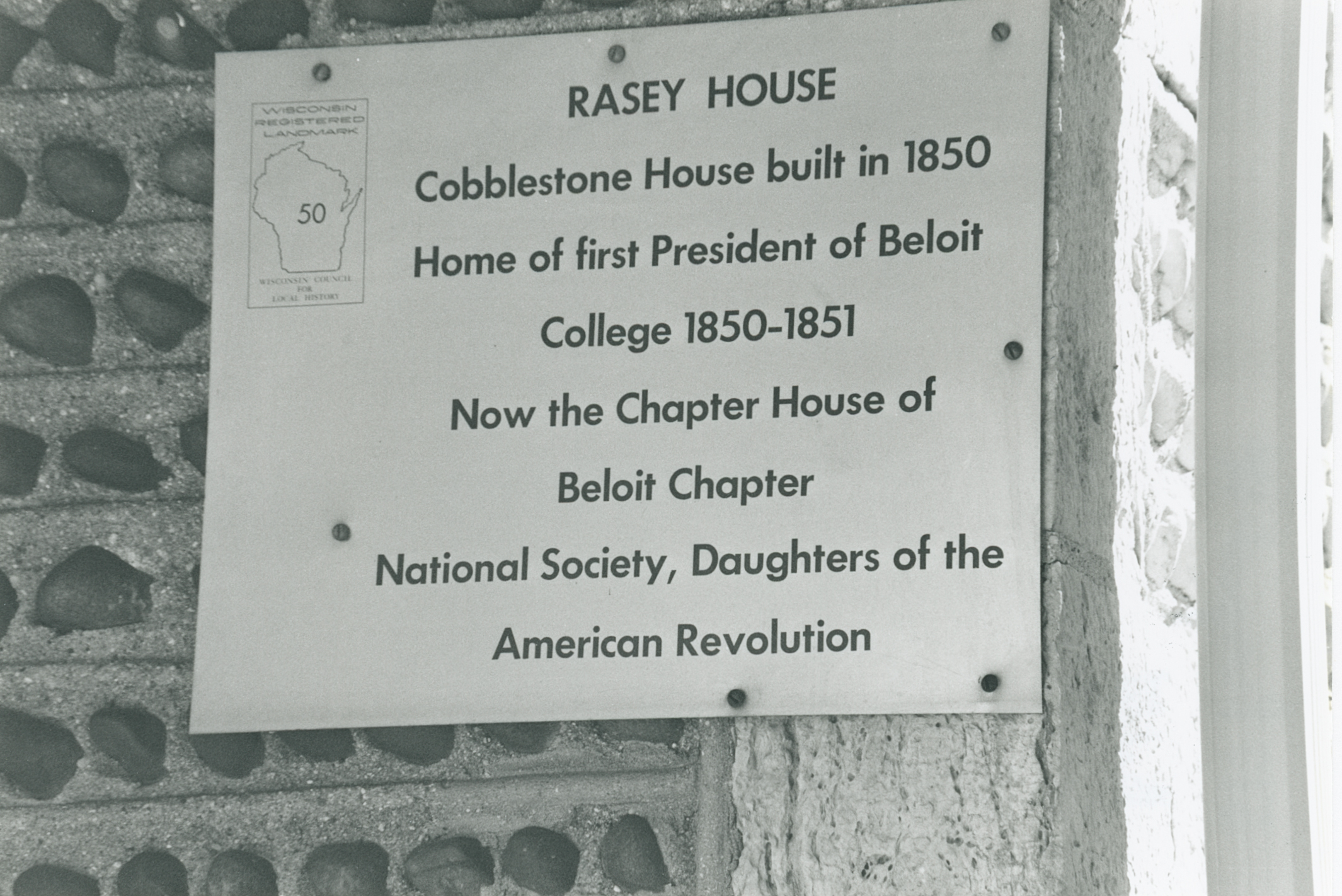 Roc-3 517 Prospect St 2.jpg ¹ | 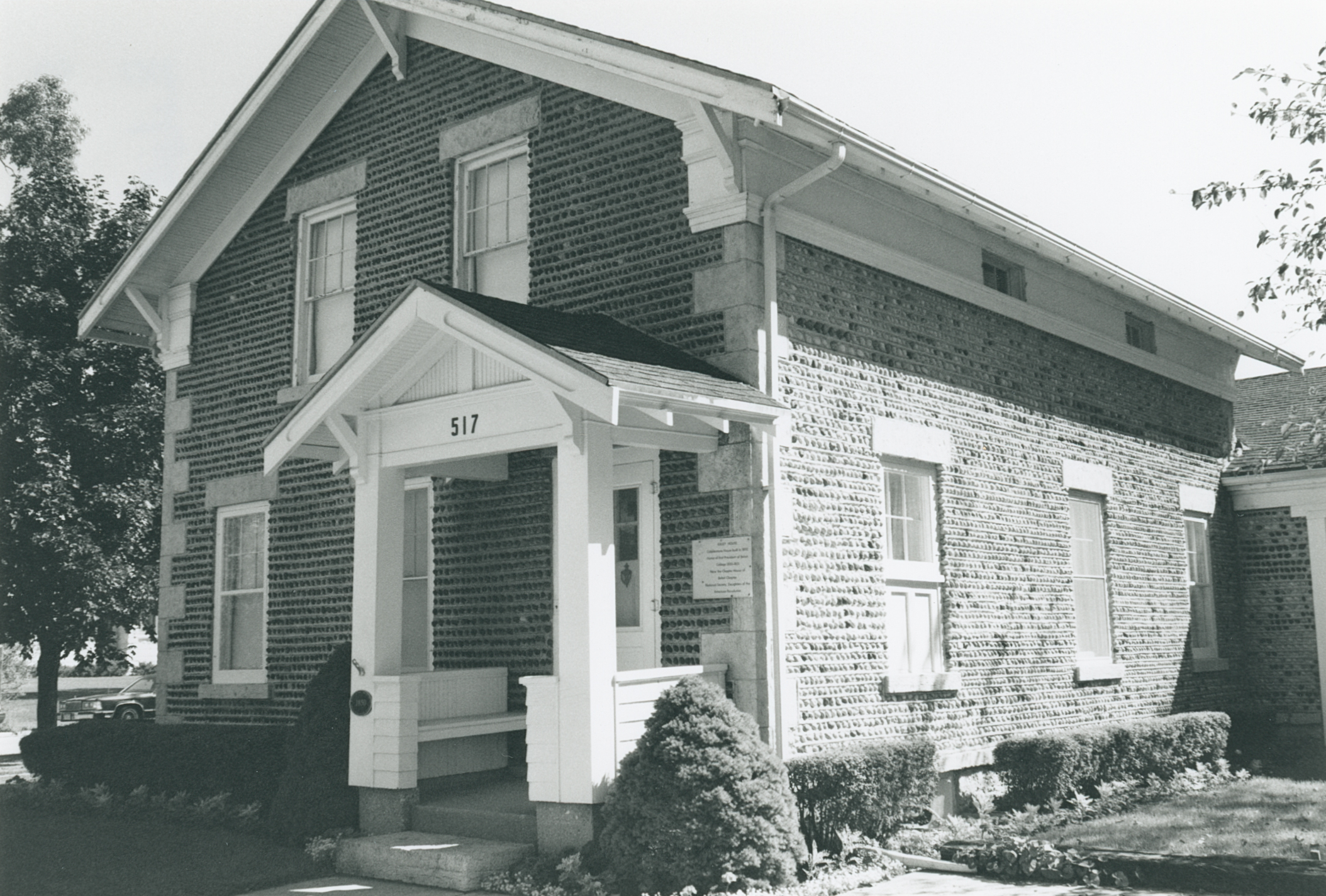 Roc-3 517 Prospect St 3.jpg ¹ | 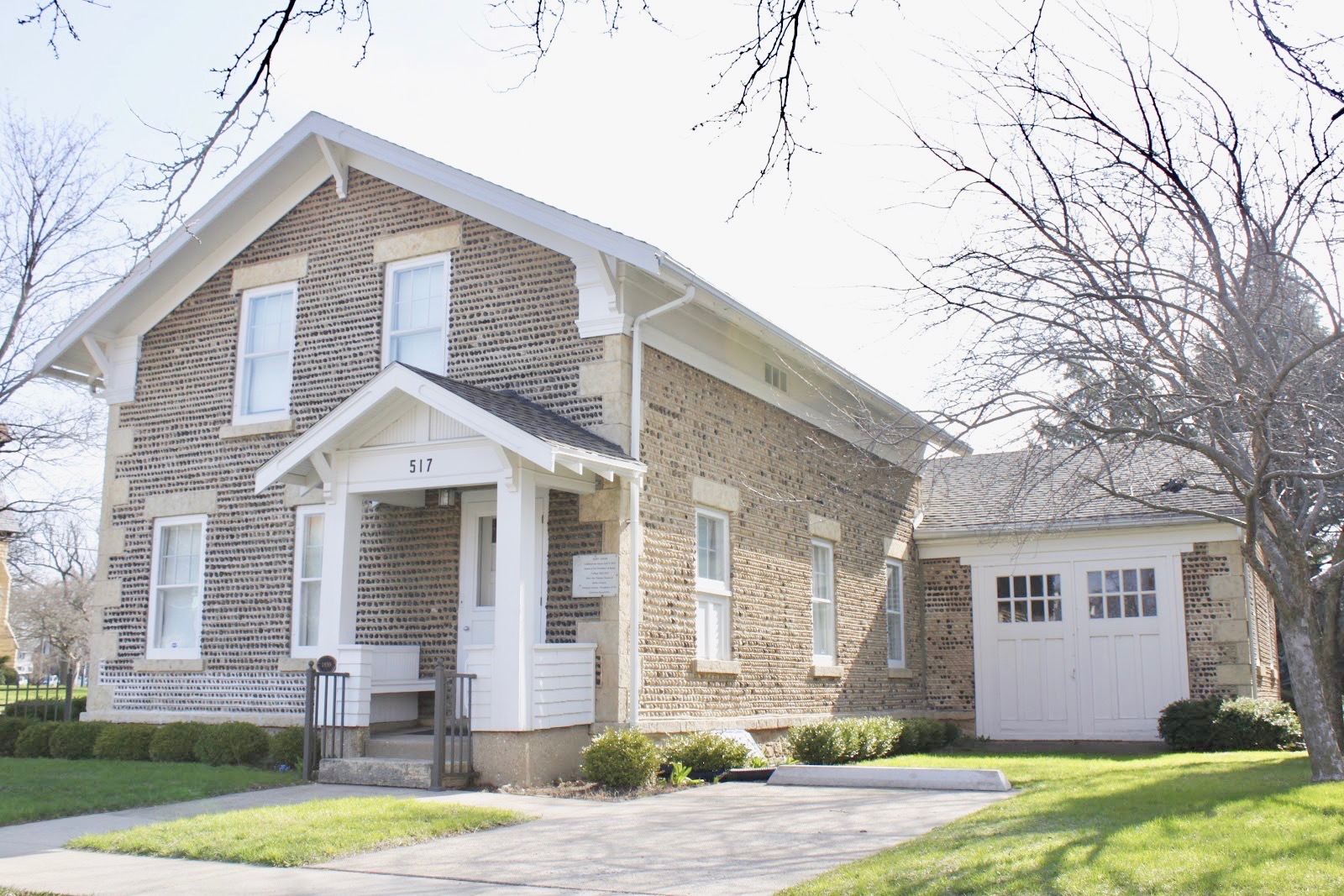 517 Prospect St., Beloit 2.jpg ² |
¹ Photography courtesy Martin and Sheila Wolfish.
² Photography courtesy Richard Palmer blog.
